27 posts tagged with "Workplace"

View All Tags

Phrasal Verb - keeping up

· 2 min read
Raymundo CH

Image illustrating the verb keeping up

Image uploaded to Pixabay by Myriams-Fotos

.

Definition

To continue at the same pace or level as others, especially in terms of work, studies, or fashion. It can also mean to stay informed about the latest trends or news.

Examples

No.Example
1I'll have to keep up with my studies if I want to get good grades.
2Despite being older, she keeps up with the latest technology.
3The fashion industry is always keeping up with the latest trends.
4If you want to keep up with your friends, you need to be more punctual.
5I find it hard to keep up with my emails these days.
6He's struggling to keep up with the demands of his new job.
7The team is doing well, we need to keep up the good work.
8I'll have to keep up my exercise routine if I want to stay fit.
9I can't keep up with the price of groceries these days.
10Let's keep up the conversation and not let it die down.

Phrasal Verb - kicking up

· 2 min read
Raymundo CH

Image illustrating the verb kicking up

Image uploaded to Pixabay by Gauger

.

Definition

  1. To cause something, such as dust or noise, to rise or be created, often unintentionally or in a violent or careless way.
  2. To begin or start something, often suddenly or enthusiastically.
  3. To complain or protest about something, often to a superior or authority figure.

Examples

No.Example
1The construction site kicked up a lot of dust, making it difficult for nearby residents to breathe.
2The partygoers started dancing and kicking up their heels.
3The children kicked up a fuss when they were told they couldn't have dessert.
4The workers kicked up a storm when they learned about the proposed layoffs.
5The politician's controversial statement kicked up a heated debate.
6The dog kicked up a rock and uncovered a bone.
7The tourists kicked up a commotion when they tried to take a picture of the president.
8The children kicked up their legs and laughed as they rode the merry-go-round.
9The chef kicked up the sauce with some spices.
10The protesters kicked up a protest against the new tax law.

Phrasal Verb - letting off

· 2 min read
Raymundo CH

Image illustrating the verb letting off

Image uploaded to Pixabay by Pezibear

.

Definition

  1. To allow someone to go or leave, especially after detaining them or keeping them waiting. 2. To release something, especially a gas or steam, suddenly and in a large quantity. 3. To excuse or pardon someone for a mistake or misbehavior. 4. To express emotions, especially anger, by using strong language or actions. 5. To relax and enjoy oneself, often after a period of hard work or stress.

Examples

No.Example
1The police let off the driver with a warning after finding him speeding.
2The factory let off a large plume of smoke into the sky.
3My boss let me off early because I had a doctor's appointment.
4After the argument, John let off some steam by hitting a punching bag.
5The students let off balloons to celebrate their graduation.
6The teacher let the class off for recess.
7The fireworks let off a loud bang, startling the crowd.
8The prisoners were let off on parole after serving their sentences.
9The dog let off a foul odor when it farted.
10After a long day at work, I let myself off and watched a movie.

Phrasal Verb - letting up

· 2 min read
Raymundo CH

Image illustrating the verb letting up

Image uploaded to Pixabay by manseok_Kim

.

Definition

  1. To reduce the pressure or intensity of something, such as work or criticism, usually temporarily. 2. To reveal a secret or betray a confidence. 3. To allow a vehicle to move, especially a car or train, by releasing the brake or throttle.

Examples

No.Example
1I need to let up on the accelerator to save fuel.
2The boss finally let up on his strict deadline.
3She let up the secret that he was the one who stole the money.
4He let up his guard when he met his old friend.
5The traffic jam eased up and we were able to continue our journey.
6The teacher let up on the class for a short recess.
7He let up the dog and it ran away.
8The pressure on the hose let up and the water flowed freely.
9The patient's condition let up enough for him to be discharged.
10The storm let up and the sun came out.

Phrasal Verb - Looking Down On

· 2 min read
Raymundo CH

Image illustrating the verb Looking Down On

Image uploaded to Pixabay by TreptowerAlex

.

Definition

To express contempt, disapproval, or superiority towards someone or something, often in a condescending or arrogant manner.

Examples

No.Example
1Despite her success, her colleagues still look down on her because of her rough upbringing.
2He looks down on manual labor and only respects those in white-collar jobs.
3The audience looked down on the performer's attempt at comedy and booed him off the stage.
4I used to look down on vegetarians, but after trying a few delicious plant-based meals, I've changed my mind.
5The new employee was initially looked down upon by her team, but she quickly proved herself.
6The wealthy businessman looked down on the homeless man, ignoring his pleas for help.
7Despite his advanced age, the elder statesman continued to look down on the younger politicians.
8The teacher looked down on the student for not completing his homework, but didn't offer any assistance.
9The fashion industry continues to look down on plus-size models, perpetuating a harmful stereotype.
10The CEO looked down on the idea of offering paid parental leave, but eventually came around after seeing the positive impact it had on employee morale.

Phrasal Verb - acting up

· 2 min read
Raymundo CH

Cartoon representing the phrasal verb acting up

Definition

Acting up is a versatile phrasal verb that primarily describes behavior or function that deviates negatively from the expected norm. In one common sense, it refers to misbehaving or behaving badly, particularly by children, pets, or individuals who are being unruly, disobedient, or causing trouble and disruption. This usage implies a deviation from good conduct or decorum. Secondly, it is frequently used to describe a malfunction, faulty operation, or improper functioning of a machine, device, or system. This could range from a car engine making unusual noises, a computer freezing unexpectedly, or an appliance not working as it should, indicating a technical issue that requires attention. Thirdly, it can be employed to describe the worsening or recurrence of a physical condition, illness, or pain, such as an old injury flaring up, an allergy manifesting symptoms, or a chronic ailment becoming more troublesome or painful. Across all contexts, 'acting up' generally conveys that something is not performing or behaving as it normally should, often leading to annoyance, inconvenience, or concern.

Examples

&#35

Examples

1The kids started acting up as soon as their parents left the room.
2My old car engine has been acting up, making a strange knocking sound.
3After a long day of hiking, my knee injury from college started acting up again.
4The computer system has been acting up all morning, causing delays in our work.
5If the dog keeps acting up like this, we'll have to consider more training.
6Her allergies always start acting up during the spring season.
7The printer in the office has been acting up, constantly jamming paper.
8Despite several warnings, the students continued acting up in the back row.
9I couldn't finish the report because my internet connection was acting up.
10My back often starts acting up after a strenuous session at the gym.

Phrasal Verb - asking out

· 2 min read
Raymundo CH

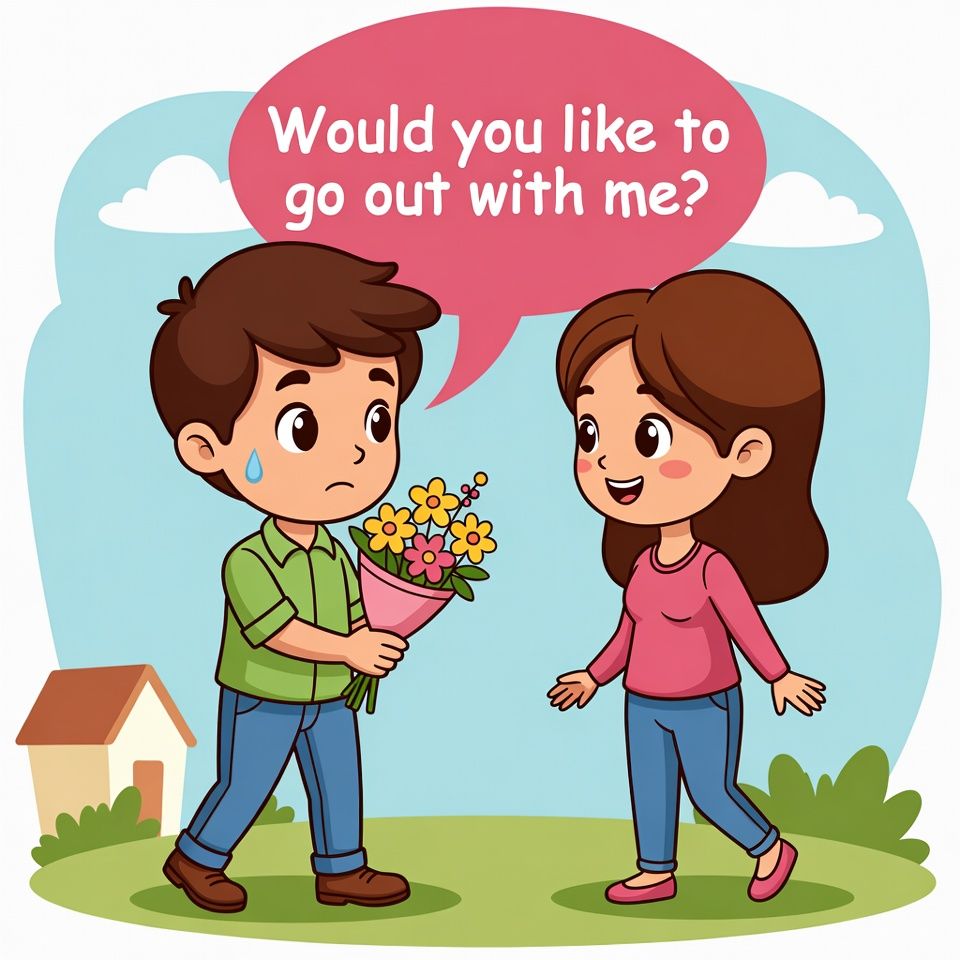
Cartoon representing the phrasal verb asking out

Definition

To invite someone, typically a person with whom one has a romantic interest, to accompany them on a date or to a social event with the implicit or explicit intention of exploring or developing a romantic relationship. This action often signifies a transition from a platonic acquaintance or friendship to a potential romantic courtship. It involves a direct proposal for a shared activity outside of casual or group interactions, such as dinner, a movie, coffee, a concert, or any other activity designed for two people to spend focused, quality time together to get to know each other better in a romantic context. The act of asking someone out can be accompanied by feelings of nervousness, excitement, or anticipation, as it carries the risk of rejection but also the potential for a new romantic connection.

Examples

No.

Examples

1He's been working up the courage to ask her out for weeks.
2Are you ever going to ask him out, or just keep admiring him from afar?
3She was pleasantly surprised when he finally asked her out to dinner.
4My friends keep encouraging me to ask out my coworker, but I'm hesitant.
5If you don't ask her out soon, someone else definitely will.
6They met at a party, and he asked her out the very next day.
7I got asked out by a really charming person yesterday!
8It took a lot of bravery for him to ask out his crush.
9Don't be afraid to ask someone out; the worst they can say is no.
10She had always wanted to ask him out, but the timing never felt right.